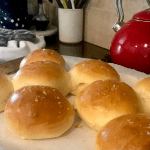
Rich and Buttery Brioche Buns
Buttery, rich, tender brioche buns are perfect for burgers or sandwiches. Plan ahead as they take 4 hours - much of which is hands off rise-time- but the result is worth the effort!
Ingredients
- 2/3 cup warm milk not hot
- 2 1/2 tsp active dry yeast
- 3/4 cup 3.5 oz all purpose flour
- 3 TBSP sugar
- 3 cups plus 2 TBSP 14 oz all purpose flour
- 1 1/2 tsp kosher salt
- 4 eggs room temperature, lightly beaten with a fork
- 1 stick 4 oz unsalted butter, softened
- cornmeal for dusting
- 1 egg whisked with 1 TBSP water
- Course sea salt for sprinkling
Instructions
- Place yeast in large bowl of stand mixer. Pour warm (not hot, 100-110 degrees f is ideal) milk over yeast and let it stand 5-10 minutes. It should be bubbly. This is called proofing your yeast and it's really just a test to make sure your yeast is alive and will do what you need it to do in your recipe. If it's not bubbly start over with new yeast.
- Add 3/4 cup flour and 3 TBSP sugar, stir to combine, cover and let stand 30 minutes. It will be nice and foamy/bubbly when it's ready. This is your sponge. Creating a sponge before adding the rest of your ingredients is key in developing the flavor and texture that make this bread so good.
- Add remaining flour, salt and lightly beaten eggs to sponge in bowl and knead with the dough hook for 4-5 minutes. It will be sticky and take a little while for all of the flour to incorporate, so scrape down the sides a couple of times with a rubber spatula while it's mixing.
- With mixer running add your butter 2 TBSP at a time, letting butter fully incorporate into dough in between each piece. You'll need to scrape bowl several times during this process.
- Once butter is incorporated continue kneading on low speed for 5 minutes until dough is smooth and shiny. You may need to add a little more flour (up to 3 Tbsp- one at a time) during this process if the dough is too sticky. keep in mind this IS a sticky dough but you don't want it completely unmanageable. If you've made bread before you will think it's too soft but it does firm up as it rises and has time to develop.
- Scrape dough into an oiled bowl large enough to hold it once doubled. I turn the dough over in the bowl to make sure all sides are lightly coated in oil. It will feel sticky and soft but ultimately be able to be shaped into a ball.
- Place bowl in a warm, draft free place, covered with a towel, for 1 1/2 hours or until doubled in size. I have a "proof" setting on my oven but before that was available I'd put it inside my oven (no heat!!!) with the light on and that provided a nice draft free atmosphere. I also put a sticky note on the oven door so no one would turn it on unaware of the dough inside.
- After dough has doubled, punch it down and fold it over itself, cover and let rest another 45 minutes.
- Have 2 baking sheets ready, covered with parchment and sprinkled generously with cornmeal ( in lieu of cornmeal you could use more flour. I like the texture the cornmeal gives the bottom of the buns)
- After 45 minutes, turn dough out onto floured surface. Get a little flour on your hands and portion dough into 8 pieces for sausage rolls or 10-12 pieces for burger buns. Working with one piece at a time shape each into balls or ovals (ovals will be about 5 inches long). Don't be afraid to use flour as you need it to keep dough from sticking (just don't knead anymore INTO the dough)
- If making burger buns: Place dough balls evenly spaced between the two sheets and press each gently just to slightly flatten
- If making sausage rolls: Arrange side by side with only about 2 inches between pieces. They'll touch slightly as they bake and this will help them keep their shape and get tall.
- Cover dough, return to warm, draft free place and let rise 20 minutes. Preheat oven to 400f and make sure your oven racks are positioned to have enough space between them for both sheets.
- While oven is heating and buns are rising whisk an egg with a TBSP of water in a small bowl. You don't want the egg to be cold when you brush it over the buns so do this now.
- After 20 minutes gently brush buns with egg wash being careful not to deflate them and sprinkle with sea salt (you want big, crunchy salt crystals for this). If you don't have sea salt you CAN use kosher or Maldon, just be careful not to use too much. Sea salt is the best for this though.
- Bake at 400f for 7 minutes and then reduce temperature to 350f for another 10-12 minutes. They will bake for a total of 17-19 minutes and it's important to adjust the temperature after 7 minutes.
- Let buns cool slightly before moving to a cooling rack
- Enjoy!
Notes
These really are best the day they're made but you can keep for one day, in a bread bag, at room temperature. Don't refrigerate because they'll dry out.
For longer storage you can wrap individually in plastic wrap and store in freezer bags in the freezer.
Leftover buns also make great croutons or garlic bread!